

A status page is often introduced during a crisis. In reality, its value extends far beyond outages.
For SaaS companies, a status page functions as a communication layer between infrastructure and customers. It clarifies what is happening, reduces confusion, and protects trust during system disruptions. As products scale and expectations increase, this layer becomes critical to operational maturity.
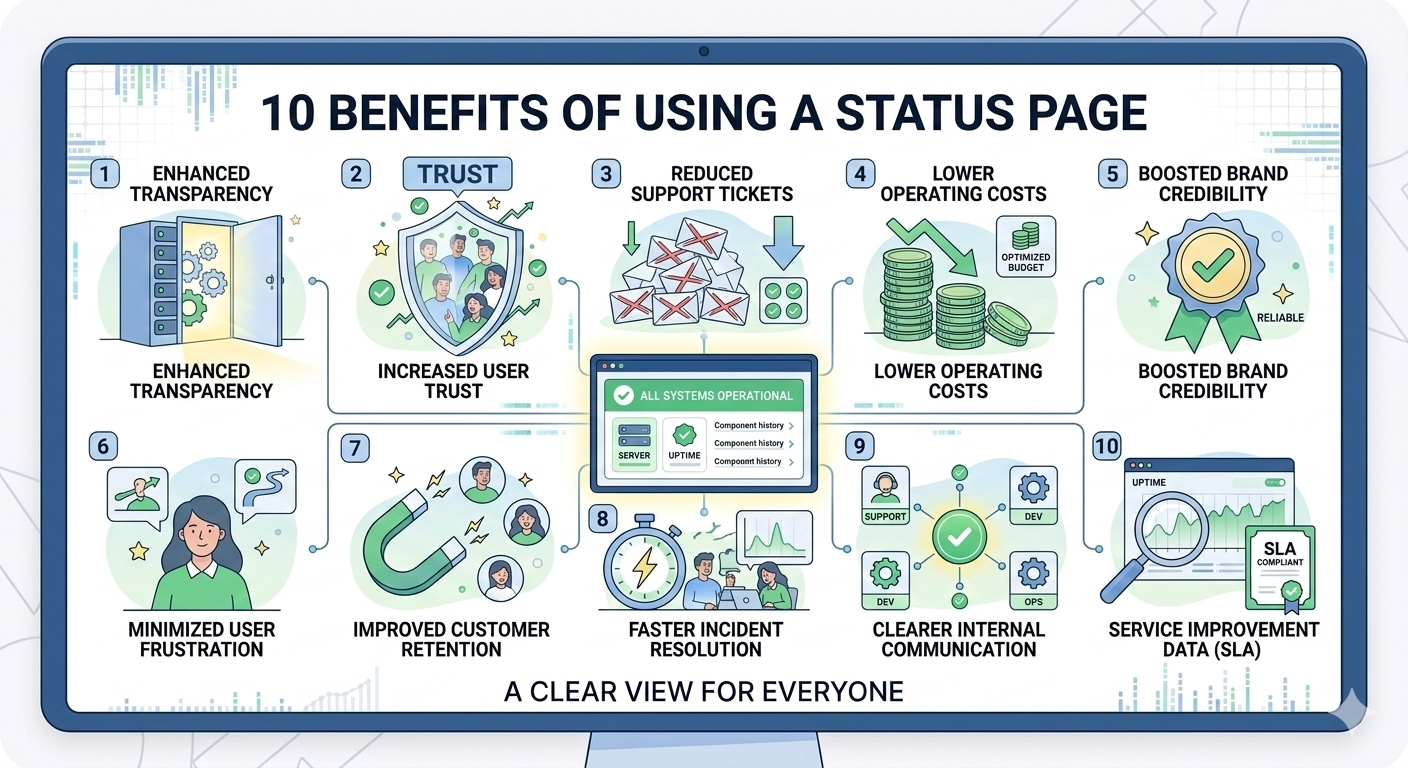
Below are ten meaningful benefits of using a status page, both during incidents and in everyday operations.
1. Enhances Transparency During Incidents
Transparency is one of the strongest signals of reliability. When an outage occurs, silence creates uncertainty. A status page immediately acknowledges the issue and provides visibility into what is affected.
Customers are far more patient when they understand the situation than when they are left to guess.
2. Builds Long-Term Customer Trust
Trust is rarely damaged by the outage itself. It is damaged by how the outage is handled.
Consistent, structured updates demonstrate responsibility and preparedness. Over time, customers begin to associate your product with controlled incident management rather than unpredictability.
Trust accumulates through communication.
3. Reduces Support Ticket Volume
One of the most immediate operational benefits of a status page is a reduction in repetitive support tickets.
When customers can independently verify service health, they are less likely to open tickets asking whether the platform is down. This frees support teams to focus on genuine issues rather than confirmation requests.
4. Improves Communication with Real-Time Updates
A status page centralizes incident communication in one location. Instead of scattered messages across email, chat, and social media, updates are structured and presented chronologically.
Real-time updates give customers clarity about impact, progress, and expected resolution timelines. This predictability reduces anxiety and confusion.
5. Strengthens Incident Management Processes
Status pages are not only external tools. They support internal discipline.
When teams know that updates will be publicly visible, incident documentation becomes more structured. Severity definitions are clearer. Resolution notes are more precise. This improves overall incident management quality.
6. Supports SLA Transparency and Compliance
For SaaS companies with Service Level Agreements, visibility is essential.
A status page documents outages, maintenance windows, and resolution timelines. This historical record strengthens SLA reporting and demonstrates accountability to enterprise customers.
Structured transparency supports contractual credibility.
7. Boosts Brand Credibility
A dedicated status page signals operational maturity. It communicates that the company expects incidents to occur and has a structured plan for handling them.
This perception matters during procurement processes, security reviews, and enterprise negotiations. Credibility is reinforced when communication feels organized rather than reactive.
8. Streamlines Internal Collaboration
A status page can act as a shared reference point across engineering, product, and support teams.
Instead of relying on fragmented updates in chat threads, teams refer to a single source of truth. This alignment reduces confusion and improves decision-making during high-pressure moments.
9. Provides Historical Uptime Data
Historical uptime data allows customers to evaluate reliability objectively. It also allows internal teams to analyze patterns and recurring issues.
Over time, this record becomes part of your operational narrative. It demonstrates consistency and improvement rather than leaving reliability claims unsupported.
10. Strengthens Customer Loyalty
Customers are more likely to stay with a product that communicates clearly during disruptions.
Even when issues occur, transparent updates reassure users that the company is in control.
That reassurance influences renewal conversations, expansion decisions, and long-term loyalty.
Reliability builds confidence. Communication preserves it.
With and Without a Status Page: The Difference in Practice
| Without a Status Page | With a Status Page |
| Customers rely on support or social media for updates | Customers check a centralized, reliable source |
| Support tickets increase during outages | Repetitive queries decrease significantly |
| Communication is reactive and scattered | Updates are structured and chronological |
| SLA reporting requires manual explanation | Outages and resolutions are documented clearly |
| Trust declines after incidents | Transparency reinforces confidence |
Bringing Structure to Incident Communication
A status page becomes most powerful when integrated into a broader communication strategy. Platforms such as Incipulse enable SaaS teams to centralize updates, notify stakeholders across channels, and maintain consistent messaging during both incidents and scheduled maintenance.
This structure ensures that communication scales alongside infrastructure.
Conclusion
A status page is not merely a response tool for outages. It is a foundational component of SaaS transparency.
It enhances communication, reduces operational noise, supports SLA compliance, strengthens brand credibility, and fosters long-term customer loyalty. As your product grows, the absence of structured communication becomes increasingly visible.
The question is not whether incidents will occur. The question is whether customers will feel informed when they do.
FAQs
Do small SaaS companies benefit from a status page?
Yes. Even early-stage SaaS platforms benefit from centralized communication. Implementing a status page early makes scaling easier as the user base grows.
Does a status page improve SEO?
It can improve search visibility by creating indexed pages for service health and incident updates. It also increases branded search clarity during outages.
Can a status page reduce churn?
Yes. Clear communication during incidents helps preserve trust, which directly influences renewals and long-term customer retention.
Meta title:
Meta description:
