
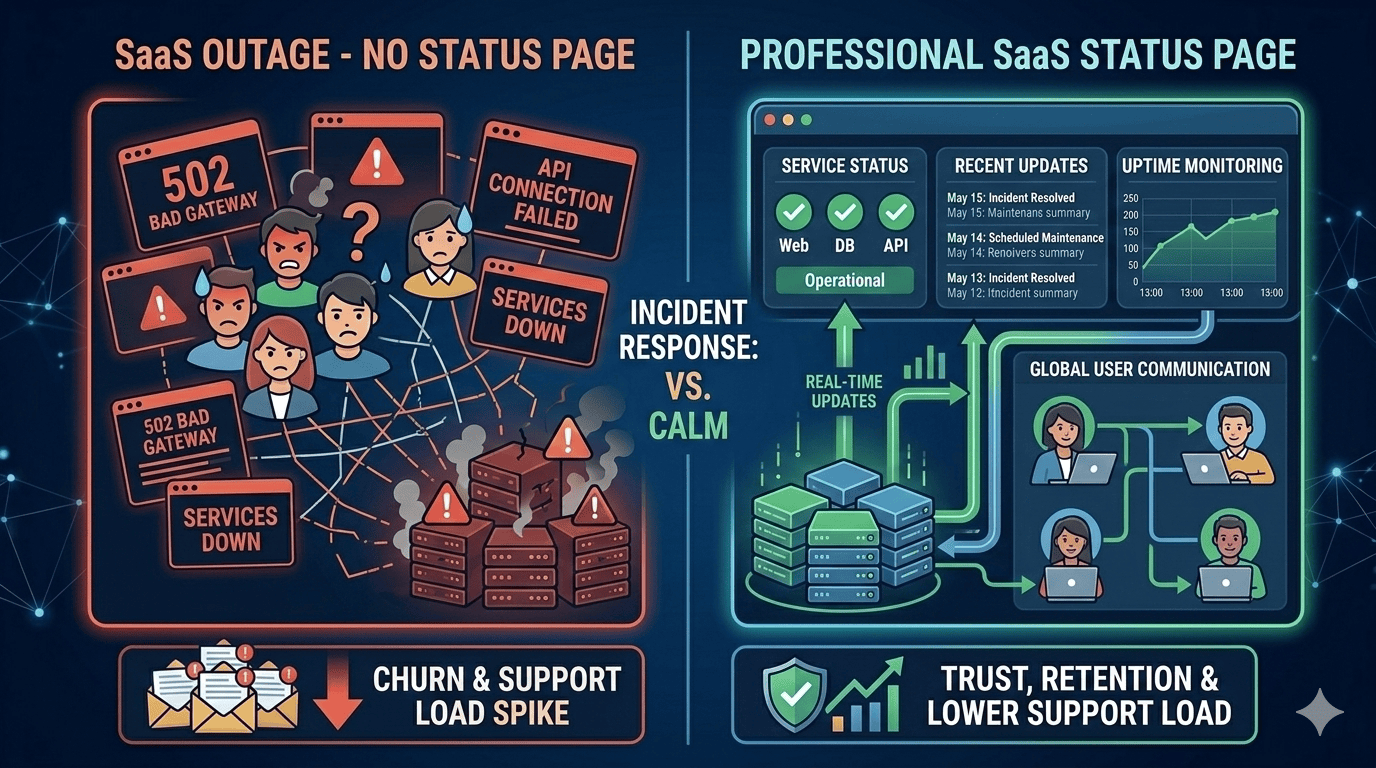

Customers rarely leave the moment an outage happens. What pushes them toward customer churn is usually the experience around the outage, not the technical failure itself.
When something breaks, and there is no explanation, users start questioning reliability. They retry actions, assume something is wrong on their side, and contact support just to confirm the issue is not isolated. Even if systems recover quickly, that uncertainty leaves an impression.
Over time, repeated confusion becomes hesitation, and hesitation often becomes churn. Status pages help prevent that shift from frustration to distrust.
Why Outages Influence Long-Term Retention
From an operational perspective, an outage might be resolved within minutes or hours. From a customer’s perspective, the experience can feel very different.
If users are left guessing, they begin to doubt stability. They wonder whether the issue will happen again without warning. In subscription businesses, especially SaaS, these doubts influence renewal decisions later. Customers may not cancel immediately, but they remember how incidents were handled.
Churn often starts as a quiet loss of confidence. In subscription businesses, that quiet loss of confidence shows up later during renewal conversations. Customers may not cancel immediately, but they hesitate to expand, upgrade, or commit long-term. Poorly handled incidents often resurface in those discussions.
Confusion Drives Churn More Than Downtime
Customers are more tolerant of downtime than most teams assume. What they struggle with is silence.
When there is no visible communication:
- users assume the issue might be permanent,
- support channels fill with repetitive questions,
- frustration builds even during short disruptions.
A status page reduces this uncertainty early. By confirming that the issue is known and under investigation, it changes how users interpret the problem. Instead of feeling ignored, they feel informed.
That shift in perception is critical.
Before and After: Customer Experience During an Outage
| Scenario | Without a Status Page | With a Status Page |
| Initial Reaction | Silence creates uncertainty | Immediate acknowledgement confirms the issue |
| Customer Behavior | Users retry repeatedly and assume it may be a local problem | Users understand it is a known issue and stop unnecessary retries |
| Support Impact | Support tickets spike with repetitive “Is it just me?” queries | Support volume reduces because updates are visible |
| Emotional Response | Frustration and anxiety increase | Patience improves due to clarity |
| Perception of Reliability | Brand appears unprepared or unresponsive | Brand appears transparent and in control |
| Long-term Effect | Confidence declines, churn risk increases | Trust is reinforced, retention improves |
The technical outage may be identical in both cases. What changes is how customers experience it and how they remember it later.
Real-Time Updates Build Reassurance During Incidents
Real-time updates do more than provide information. They show responsiveness.
When customers see that updates are being posted as the situation evolves, they gain confidence that the team is actively engaged. Even if the fix takes time, the visibility reduces anxiety.
Many SaaS teams notice that when status updates are frequent and clear, support ticket volume drops noticeably during incidents. Users no longer contact support simply to ask what is happening. That reduction in friction improves the overall customer experience during high-stress moments.
Clear Timelines Help Customers Make Decisions
Customers do not expect exact resolution times. They expect guidance.
A simple estimate or a commitment to share the next update at a specific time helps users plan. It tells them whether to wait, adjust their workflow, or return later. Without that clarity, they remain in a state of uncertainty, which often feels worse than the outage itself.
Over time, predictable communication builds confidence in how incidents are managed.
Transparency During Failure Builds Stronger Loyalty
Trust is rarely built when everything works perfectly. It is built when something goes wrong, and communication stays steady.
When customers consistently see early acknowledgement, structured updates, and clear closure, they begin to trust the process. They may still be inconvenienced, but they are less likely to interpret incidents as signs of deeper instability.
That distinction matters for retention.
How Status Pages Reduce Support-Driven Churn
Support interactions often influence long-term perception. If customers repeatedly experience slow or unclear responses during outages, frustration compounds.
Status pages reduce this pressure by proactively answering common questions. Instead of opening tickets just to confirm that something is broken, users can check the status page and find the information they need. This lowers support strain and improves the tone of customer interactions.
Calmer support conversations often lead to stronger retention outcomes.
The Impact Of Repeated Small Incidents
Major outages are obvious churn risks. Smaller, poorly communicated incidents are often more damaging over time.
If customers experience several short disruptions without explanation, they begin to expect instability. Even if each issue is minor, the pattern shapes perception. A consistent status page interrupts that pattern by showing acknowledgement every time something goes wrong.
Consistency is what protects trust.
Closing The Loop After Resolution
Churn does not always happen during an outage. It often happens afterwards, when customers feel uncertain about whether the issue is truly resolved.
A final update confirming resolution, and occasionally a brief explanation of what happened, helps close the loop. It reassures customers that the issue was understood and addressed properly.
That closure reinforces confidence instead of leaving lingering doubt.
Conclusion
Status pages do not eliminate incidents, but they reduce the uncertainty that turns incidents into churn events.
By keeping customers informed, sharing timelines, and communicating transparently, status pages protect trust during failure. In subscription-based businesses, that trust directly influences whether customers stay or leave.
Reducing churn is not about preventing every outage. It is about protecting trust when outages happen. It is about ensuring customers never feel abandoned when outages occur through resourceful platforms like Incipulse.
FAQs
Can a status page directly impact customer retention?
Yes. Clear communication during incidents fosters trust, which in turn significantly influences renewal decisions in subscription models.
Do customers actually check status pages during outages?
Yes. Especially in SaaS and infrastructure products, users actively seek confirmation that issues are known and being addressed.
Is a status page enough to prevent churn?
It is not the only factor, but it significantly reduces confusion and frustration during incidents, which are common drivers of churn.
