
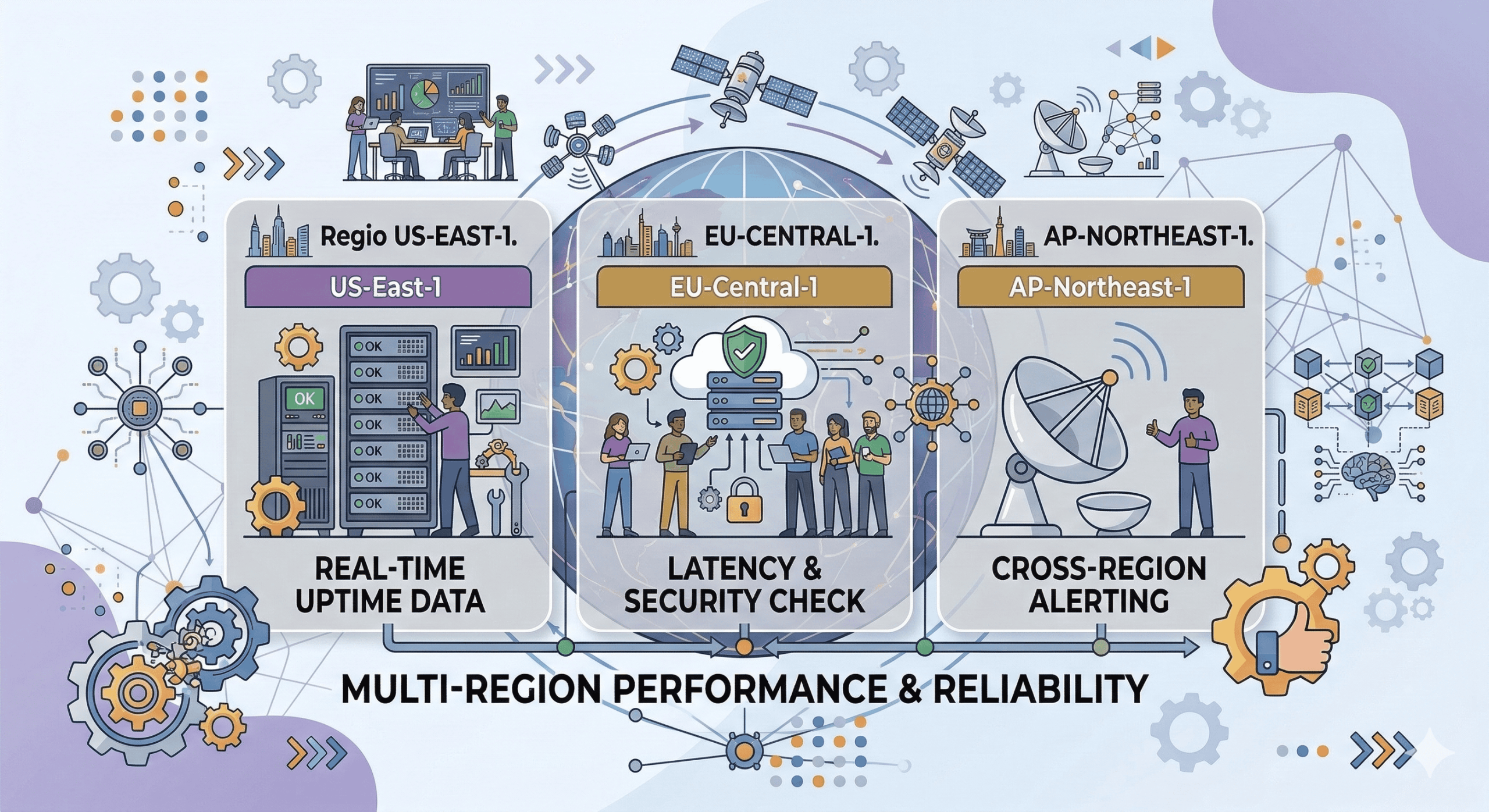

If your monitoring only checks whether your product is “up,” you’re missing the bigger picture.
Modern SaaS failures are rarely global. They’re regional, partial, and uneven. A product might work perfectly in one geography while users in another region experience slow load times, broken logins, or complete unavailability.
This is why multi-region monitoring isn’t just a reliability practice; it’s a trust and visibility strategy. It helps you detect failures that traditional monitoring often misses.
Why Regional Failures Happen in the First Place
Before considering how to monitor across regions, it is essential to understand why regional failures are so common.
Most SaaS stacks today rely on:
- CDNs
- DNS providers
- Cloud regions
- Third-party APIs
- ISP routing paths
Each of these behaves differently depending on geography.
CDN and Edge Failures
CDNs serve traffic from edge locations closest to users. If an edge node in one region fails or becomes overloaded, only users routed to that node are affected.
From another region, everything looks fine.
Anycast Routing Issues
Many global services use Anycast IPs. Traffic is routed to the “nearest” node based on network conditions, not physical distance. Routing changes can silently redirect traffic through degraded paths in specific regions.
DNS Propagation and Resolver Differences
DNS resolution isn’t uniform. Different ISPs and regions may cache or resolve records differently. A DNS issue can affect Europe but not Asia, or mobile users but not broadband users.
ISP-Specific Problems
Packet loss, throttling, or peering disputes often affect only specific networks within a region.
All of this leads to the same dangerous outcome: Your monitoring looks healthy while real users are struggling.
Why Single-Region Monitoring Is Structurally Insufficient
Single-region monitoring answers only one question: “Is the service reachable from here?”
It does not tell you:
- Whether performance is acceptable elsewhere
- Whether users are experiencing partial failures
- Whether routing or CDN issues exist
- Whether the issue is isolated or spreading
This is why teams often learn about regional incidents from support tickets first, which is already too late.
What Advanced Multi-Region Monitoring Actually Tracks
At an advanced level, you’re not just monitoring availability. You’re tracking experience variance.
That includes:
- Uptime by region
- Latency by region
- Error rates by geography
- Degradation patterns over time
- Correlation between regions
This shifts monitoring from binary (“up/down”) to diagnostic.
Step 1: Map Monitoring Regions to User Reality (Not Geography)
Advanced monitoring doesn’t start with continents. It starts with user concentration and risk.
You should prioritise regions based on:
- User density
- Revenue concentration
- SLA commitments
- Regulatory sensitivity
- Historical incident frequency
A common mistake is monitoring “one per continent.”
A better approach is to monitor where failure would hurt the most.
Step 2: Separate Regional Availability from Regional Performance
An endpoint can be “up” but unusable. Advanced setups always track:
- Availability (can you connect?)
- Latency (how long does it take?)
- Stability (is performance consistent?)
Regional latency spikes are often the first signal of deeper issues — especially CDN or routing problems.
If you only alert on downtime, you’ll miss early warning signs.
Step 3: Use Synthetic Monitoring Strategically
Synthetic monitoring is ideal for regional visibility because:
- It runs from controlled locations
- It’s consistent and repeatable
- It detects issues before users complain
For advanced setups:
- Run identical checks from multiple regions
- Compare response times region-to-region
- Track deltas, not just absolute numbers
A sudden divergence between regions matters more than raw latency.
Step 4: Complement With Real User Monitoring (RUM)
- Synthetic monitoring tells you what should happen.
- Real User Monitoring tells you what is happening.
- Advanced teams combine both.
RUM helps you:
- Validate whether regional issues affect real users
- Identify which geographies experience friction
- Detect ISP-specific or device-specific patterns
When synthetic and RUM signals align, confidence is high. When they don’t, investigation becomes targeted instead of reactive.
Step 5: Classify Failures by Scope
One of the most valuable outcomes of multi-region monitoring is failure classification.
You should be able to answer:
- Is this regional or global?
- Is it partial or total?
- Is it degrading or hard-down?
- Is it spreading or contained?
This classification directly informs:
- Alert severity
- Incident escalation
- User communication
Without regional data, everything looks like a mystery.
Step 6: Design Alerts Around Regional Correlation
Advanced alerting is about patterns, not individual failures.
Avoid alerts when:
- One region fails briefly
- The issue resolves within a short window
- No user-impacting metrics change
Trigger alerts when:
- Multiple checks fail in the same region
- Latency degrades consistently
- Failures persist beyond thresholds
- High-impact regions are affected
This dramatically reduces alert fatigue while improving signal quality.
Step 7: Use Regional Data to Communicate Precisely
Regional monitoring improves how you communicate incidents.
Instead of:
“We’re experiencing issues.”
You can say:
“Users in Europe may experience degraded performance. Other regions are unaffected.”
This precision:
- Reduces panic
- Prevents unnecessary workarounds
- Builds trust through honesty
This is where platforms like Incipulse become valuable by connecting regional monitoring insights to clear, user-facing communication without over-alerting unaffected users.
Common Advanced-Level Mistakes to Avoid
- Treating all regions equally
- Alerting on single-point regional failures
- Ignoring latency trends
- Relying only on uptime checks
- Failing to correlate monitoring with user reports
- Communicating globally for regional issues
Advanced monitoring is as much about decision quality as detection.
Why Multi-Region Monitoring Is a Trust Strategy
From a user’s perspective, reliability is local. If your product fails in their region, global uptime numbers don’t matter.
When you detect regional issues early:
- Users feel understood
- Support conversations improve
- Incident response feels competent
- Trust is preserved
That’s the real value of advanced multi-region monitoring.
Conclusion
The internet isn’t uniform. Your users aren’t either. Advanced multi-region monitoring acknowledges this reality. It replaces assumptions with evidence, guesses with signals, and reactive firefighting with informed response.
If your SaaS serves users across regions, your monitoring strategy should reflect how your infrastructure and the internet itself actually behaves.
FAQs
Is multi-region monitoring necessary if my cloud provider has global redundancy?
Yes. Cloud redundancy doesn’t protect against CDN failures, DNS issues, ISP problems, or routing anomalies that affect users unevenly.
Should every endpoint be monitored regionally?
No. Prioritise user-critical flows first. Expand coverage as you learn where failures hurt most.
Can multi-region monitoring reduce incident resolution time?
Yes. It helps you localise issues faster, rule out false positives, and focus the investigation where it actually matters.
