

Many SaaS companies believe reliability alone is enough to maintain customer trust. In reality, reliability and communication are inseparable. Even a technically short outage can feel long and chaotic when customers do not know what is happening.
A status page is not a branding asset or a decorative feature. It is an operational tool that becomes essential once your product reaches a certain level of usage, complexity, or customer expectation. If your SaaS is growing and you are unsure whether you need one, the indicators are usually visible in daily operations.
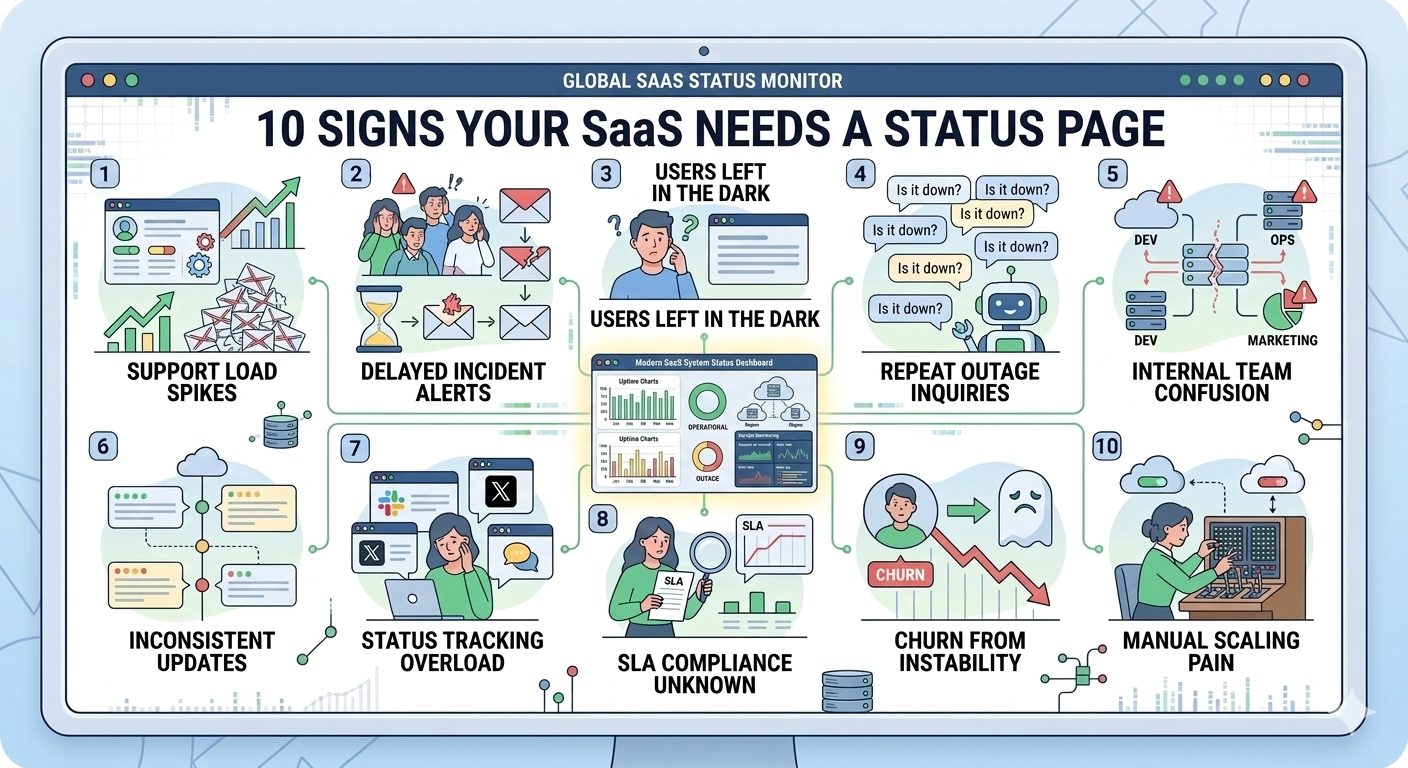
Below are ten clear signs that your platform would benefit from a structured, public status page.
1. Customers Regularly Ask Whether the Platform Is Down
When users cannot easily verify system health, they reach out to support to confirm whether the issue is widespread. These “Is it down?” queries are not just minor annoyances. They are signals that customers lack a reliable source of truth.
If your team frequently responds to such messages during slowdowns or outages, a status page would reduce confusion immediately.
2. Support Volume Surges During Incidents
An unexpected spike in tickets during outages is one of the clearest operational signs. Instead of focusing on diagnosing and resolving the issue, your support and engineering teams must repeatedly answer identical questions.
A status page centralizes communication so that a single update can serve thousands of users at once. This preserves internal focus during critical moments.
The Cost of Poor Incident Communication
Industry research consistently shows that downtime is expensive, but the secondary cost of poor communication is often underestimated. According to a widely cited Gartner estimate, the average cost of IT downtime is approximately $5,600 per minute, depending on industry and scale.
While not every SaaS company operates at enterprise scale, the principle remains relevant. When outages occur without clear communication, the financial impact compounds through support overload, churn risk, and reputational damage. A status page cannot prevent downtime, but it significantly reduces the operational and trust-related costs that follow.
3. You Have SLA Commitments or Enterprise Clients
Service Level Agreements increase the importance of transparency. Enterprise customers expect visibility when disruptions occur, not silence or scattered updates.
Without a structured status page, communication relies on manual coordination, increasing the risk of inconsistencies. A public system health page demonstrates accountability and operational maturity.
4. Your User Base Is Expanding Rapidly
As your customer base grows, the impact of communication gaps grows as well. What was manageable when serving a few hundred users becomes overwhelming at scale.
A minor outage affecting a large user base quickly turns into a reputational issue if updates are unclear. Growth increases the need for scalable communication mechanisms.
5. You Perform Scheduled Maintenance That Impacts Availability
Routine maintenance is part of running a SaaS product. However, customers should not discover maintenance only when features become temporarily unavailable.
A status page lets you clearly announce maintenance windows, set expectations, and provide reminders. Predictable communication reduces frustration and reinforces professionalism.
6. Incidents Often Affect Specific Features or Regions
As infrastructure becomes more complex, not all incidents impact every user equally. Certain APIs, regions, or modules may degrade while others remain stable.
Without a component-level status view, customers struggle to understand whether they are affected. A structured status page clarifies scope and reduces unnecessary escalation.
7. Social Media Becomes Your Primary Outage Channel
If your team relies on posting updates to social media during incidents, communication becomes fragmented. Social platforms are not designed to serve as structured system health dashboards.
A dedicated status page provides a persistent and centralized location for accurate updates, rather than scattering information across channels.
8. Internal Teams Lack a Unified View During Incidents
Communication gaps are not always external. Sometimes, engineering, support, and product teams rely on scattered updates across chat threads and emails.
A status page can serve as a shared reference point, ensuring that both internal teams and customers refer to the same information. This alignment reduces decision friction.
9. Customers Reference Past Incidents in Renewal Conversations
When reliability concerns surface during contract renewals or expansion discussions, communication history often plays a role. Customers remember how incidents were handled.
If previous outages led to confusion or inconsistent updates, that experience may influence long-term trust. A status page helps ensure that future incidents are handled transparently.
10. Trust Feels Harder to Maintain After Outages
The most subtle sign appears in customer sentiment. If users become more cautious after disruptions, ask more reliability-related questions, or hesitate to adopt new features, confidence may have weakened.
Clear, structured communication during incidents prevents temporary issues from becoming long-term trust problems.
What a Status Page Changes in Practice
The technical event may remain the same, but the experience differs significantly.
Without a status page, incidents often lead to repeated retries, rising ticket volume, inconsistent messaging, and growing frustration. With a status page, customers see acknowledgement, understand impact, and receive updates in a predictable format.
That shift in experience influences how customers evaluate your reliability over time.
Solutions such as Incipulse enable SaaS teams to centralize updates, notify stakeholders across communication channels, and maintain structured transparency during both outages and maintenance windows.
With and Without a Status Page: The Operational Difference
| Without a Status Page | With a Status Page |
| Customers are unsure whether the issue is widespread | Customers can immediately verify system status |
| Repeated retries and “Is it down?” support queries increase | A single update answers thousands of users at once |
| Support teams become overloaded during incidents | Support teams remain focused on resolution |
| Communication is scattered across email, chat, and social media | Updates are centralized in one reliable location |
| SLA transparency relies on manual explanations | SLA visibility is documented and structured |
| Customer frustration escalates quickly | Customers wait with context and clearer expectations |
| Past incidents damage renewal conversations | Transparent communication strengthens long-term trust |
Conclusion
A status page becomes necessary when your SaaS reaches a scale where silence during incidents is no longer acceptable.
Frequent outages, growing support load, SLA obligations, expanding user bases, and fragile trust are all indicators that the communication infrastructure must evolve alongside technical infrastructure.
Reliability builds trust. Transparent communication protects it.
FAQs
At what stage should a SaaS company launch a status page?
A status page should be implemented before reliability becomes a visible issue. If you are already seeing support spikes during incidents, customer confusion, or SLA commitments, the need is immediate rather than optional.
Does a status page matter if outages are rare?
Yes. Rare outages can cause more confusion because customers are not prepared for them. A structured status page ensures that even infrequent disruptions are communicated clearly and professionally.
Can a status page reduce customer churn?
It can reduce churn risk. Customers are generally tolerant of occasional issues, but they are far less tolerant of silence. Clear, timely communication during incidents preserves trust, which directly influences renewals.
Is a status page only for large SaaS companies?
No. Even early-stage SaaS platforms benefit from having a single, consistent place to communicate maintenance and incidents. The earlier it is implemented, the easier it scales as growth increases.
How does a status page support SLA transparency?
A status page provides documented visibility into outages, maintenance windows, and resolution timelines. This structured transparency reinforces SLA commitments and strengthens enterprise credibility.
