
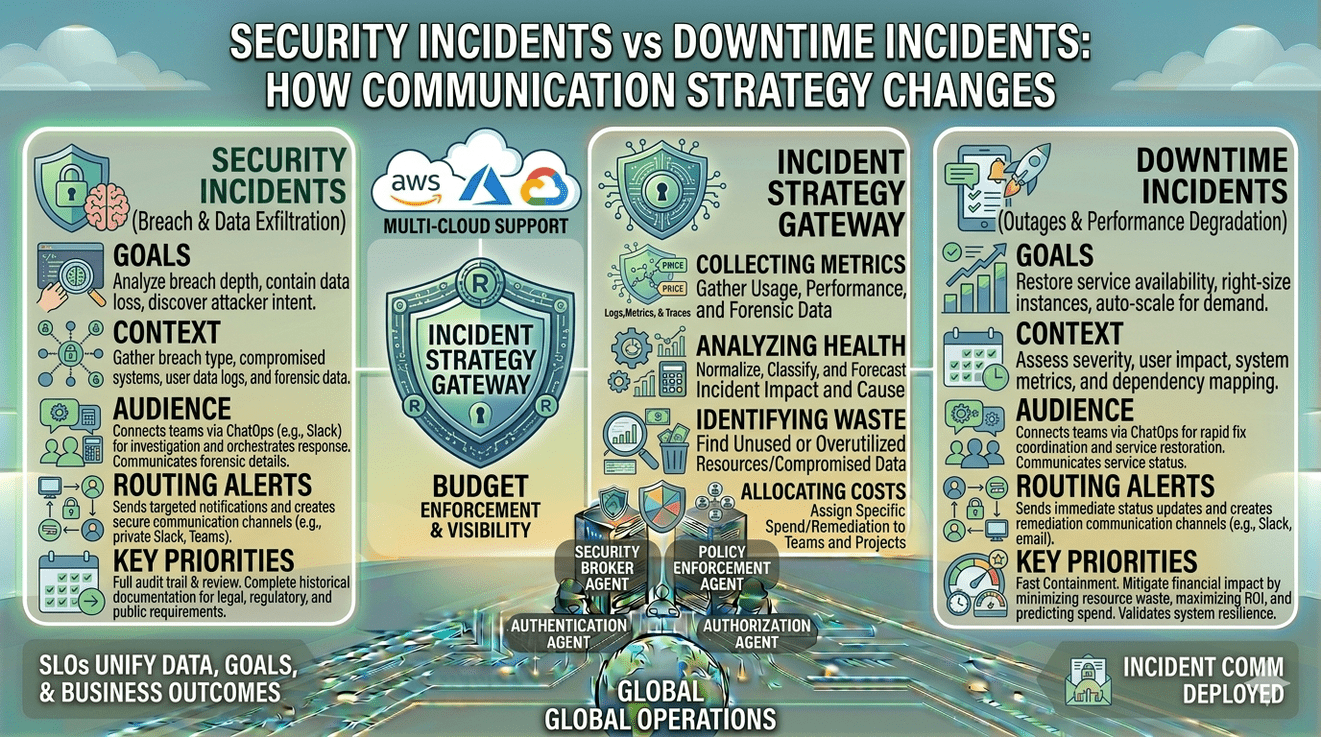

Not all incidents should be communicated the same way.
A server outage and a data breach may both disrupt service, but they create very different risks for the business and for customers. Treating them with the same communication approach is where many teams go wrong.
Downtime incidents are operational failures. The priority is restoring service and keeping users informed. Security incidents, on the other hand, involve potential compromise, legal exposure, and adversarial behavior. The priority shifts from transparency alone to controlled, accurate, and carefully timed communication.
Understanding this difference is critical. The way you communicate during each type of incident directly affects customer trust, regulatory compliance, and long-term reputation.
Why the Type of Incident Changes the Communication Strategy
At a surface level, both types of incidents require updates, acknowledgement, and resolution. However, the intent behind the communication is different.
In downtime incidents, users want clarity. They need to know what is broken, what is being done, and when it will be fixed. Over-communicating is rarely a problem here. In fact, frequent updates often reduce frustration.
In security incidents, the situation is more complex. Information must be shared responsibly because premature or excessive disclosure can:
- Create panic
- Expose vulnerabilities
- Interfere with investigations
- Increase legal risk
This means communication must balance transparency with control.
What Defines a Downtime Incident
Downtime incidents are typically caused by technical failures such as:
- Server outages
- Infrastructure issues
- Deployment errors
- API failures
- Network disruptions
These incidents are usually unintentional and operational in nature. The primary impact is service unavailability or degraded performance.
From a communication perspective, downtime incidents are relatively straightforward. The goal is to keep users informed and reduce uncertainty while the issue is being resolved.
What Defines a Security Incident
Security incidents involve intentional or potentially malicious activity, including:
- Data breaches
- Unauthorized access
- Account takeovers
- Vulnerability exploitation
- Insider threats
These incidents carry additional layers of risk beyond service disruption. They may involve sensitive data, regulatory obligations, and external threat actors.
Because of this, communication must be more controlled and coordinated across legal, security, and leadership teams.
How Communication Goals Differ
The most important difference lies in the objective of communication.
| Incident Type | Primary Goal |
| Downtime Incident | Reduce confusion and maintain trust through transparency |
| Security Incident | Protect users, manage risk, and control information disclosure |
In downtime incidents, communication is about visibility. In security incidents, it is about responsibility.
Communication Approach for Downtime Incidents
During downtime, speed and clarity matter most.
Users expect immediate acknowledgement. Even a simple update confirming that the issue is known and being investigated helps reduce uncertainty. Regular updates provide reassurance that progress is being made.
Effective downtime communication typically includes:
- Early acknowledgement
- Clear description of affected services
- Frequent updates on progress
- Estimated timelines or next update windows
- Confirmation when the issue is resolved
Silence during downtime is often interpreted as lack of control. This is why structured, real-time communication is critical.
Platforms such as Incipulse help teams maintain consistent updates across status pages, Slack, Teams, email, and SMS, ensuring that users receive timely information without confusion.
Communication Approach for Security Incidents
Security incidents require a more cautious and layered approach.
Immediate communication is still important, but it must be accurate and aligned with investigation findings. Sharing incomplete or incorrect information can create additional risk.
Key considerations include:
- Verifying the scope of the incident before public disclosure
- Coordinating with legal and compliance teams
- Avoiding disclosure of sensitive technical details
- Providing guidance to affected users
- Communicating actions taken to contain the issue
Unlike downtime incidents, where frequent updates are encouraged, security incident updates must be deliberate and controlled.
The tone also changes. Messaging becomes more formal, precise, and responsibility-driven.
Transparency vs Control: Finding the Balance
One of the biggest challenges in security incidents is balancing transparency with control.
Too little communication creates distrust. Users may assume the situation is worse than it is. Too much or poorly timed communication can expose vulnerabilities or create unnecessary panic.
The goal is not to hide information. It is to share the right information at the right time.
For example:
- Acknowledge the incident once confirmed
- Share what is known without speculation
- Provide clear user guidance
- Update when verified information is available
This approach maintains credibility while minimizing risk.
Speed of Communication: Fast vs Deliberate
Speed plays different roles in each type of incident.
In downtime incidents, speed is critical. Early acknowledgement reduces confusion and support load. Even partial updates are better than silence.
In security incidents, speed must be balanced with accuracy. Premature statements can lead to misinformation and legal complications. A slightly delayed but verified update is often preferable to a rapid but incorrect one.
This difference often defines how users perceive the organization’s response.
Internal Coordination Requirements
Downtime incidents are usually handled primarily by engineering and operations teams.
Security incidents require broader coordination:
- Security teams investigate and contain the issue
- Legal teams assess regulatory obligations
- Leadership teams manage external communication
- Support teams handle customer queries
This multi-layered coordination makes communication slower but necessary.
Customer Expectations in Each Scenario
Customer expectations also differ significantly.
During downtime:
- Users expect frequent updates
- They want to know when service will be restored
- They value transparency over perfection
During security incidents:
- Users expect responsibility
- They want to know if their data is affected
- They look for clear guidance on next steps
- They value accuracy and accountability over speed
Understanding these expectations helps shape communication tone and timing.
Common Mistakes to Avoid
A common mistake is using the same communication template for both types of incidents.
For example:
- Treating a security breach like a standard outage update
- Over-disclosing technical details during an active security investigation
- Delaying downtime updates while waiting for complete root-cause analysis
Each of these mistakes damages trust in different ways.
Another issue is inconsistency across channels. Conflicting updates during sensitive incidents can quickly escalate confusion.
Security vs Downtime: A Practical Comparison
| Factor | Downtime Incident | Security Incident |
| Nature | Operational failure | Potential malicious activity |
| Communication Style | Open and frequent | Controlled and verified |
| Speed | Immediate updates | Deliberate and accurate |
| Risk | Service disruption | Legal, reputational, and security risk |
| Audience Need | Clarity and timelines | Guidance and reassurance |
| Detail Level | High transparency | Limited, need-to-know basis |
This comparison highlights that the communication strategy must adapt based on the nature of the incident.
Conclusion
Downtime incidents and security incidents may appear similar at a high level, but they require fundamentally different communication strategies.
Downtime communication prioritizes speed, clarity, and transparency to reduce confusion and maintain user trust. Security incident communication prioritizes control, accuracy, and responsibility to manage risk and protect users.
Organizations that understand this distinction respond more effectively under pressure. They avoid over-communication in sensitive situations and under-communication during operational disruptions.
In both cases, communication is not just a support function. It is a critical part of incident management itself.
FAQs
Why can’t the same communication strategy be used for all incidents?
Because different incidents carry different risks. Downtime incidents mainly affect availability, while security incidents involve data protection, legal exposure, and adversarial behavior. Each requires a tailored approach.
Should companies delay communication during security incidents?
Communication should not be delayed unnecessarily, but it should be verified before being shared. Accuracy is more important than speed in security-related situations.
Why is transparency more important during downtime incidents?
Because users are primarily concerned with service availability. Clear and frequent updates reduce uncertainty and prevent frustration.
What is the biggest risk in security incident communication?
The biggest risk is sharing incorrect or sensitive information too early, which can lead to legal issues, reputational damage, or further exploitation.
