
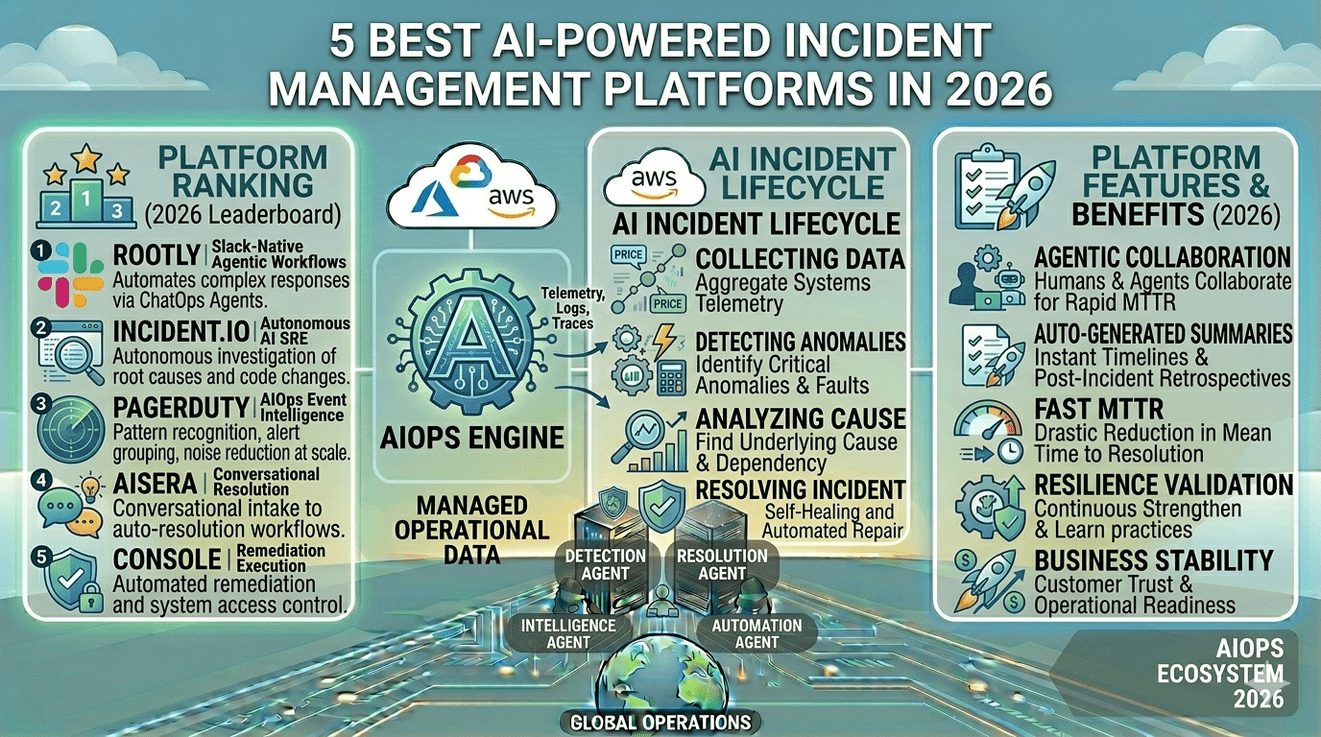

Most incident management tools today claim to be “AI-powered.” Very few actually reduce the time it takes to resolve incidents.
That difference matters.
In 2026, the value of an incident management platform is no longer defined by alerting or dashboards. It is defined by how much manual work it removes during an incident. The best platforms do not just summarize alerts. They automate coordination, reduce noise, guide actions, and keep communication aligned across teams.
This shift is driven by the complexity of modern systems. Distributed architectures, microservices, and continuous deployments create environments where incidents evolve quickly. Human coordination alone is no longer enough.
The platforms listed below stand out because they actively reduce operational friction during incidents, not just improve visibility.
What Actually Makes an Incident Platform “AI-Powered” in 2026
The term “AI-powered” is widely used, but the depth of implementation varies significantly.
Basic capabilities include:
- Alert summarization
- Incident timeline generation
- Simple anomaly detection
More advanced capabilities include:
- Intelligent alert grouping and prioritization
- Root cause suggestions
- Automated workflow execution
- Context-aware escalation
- Cross-system correlation
The distinction is important.
Some tools help you understand incidents faster.
The best tools help you resolve them faster.
Why Most “AI-Powered” Tools Still Don’t Reduce MTTR
One of the biggest misconceptions in this space is that adding AI automatically improves incident response.
In reality, many platforms label themselves as AI-powered because they offer summarization or alert grouping. While useful, these features do not fundamentally change how incidents are resolved.
The real bottleneck is not visibility. It is execution.
Teams already know something is wrong. The delay comes from:
- understanding impact
- identifying ownership
- coordinating actions
- executing fixes
- communicating updates
Platforms that only summarize data still leave these steps manual.
This is why the most effective tools in 2026 are workflow-driven. They remove steps from the incident lifecycle by:
- assigning ownership automatically
- triggering runbooks
- synchronizing communication
- reducing coordination overhead
That is where real MTTR reduction happens.
1. Incipulse — Best for Structured, Multi-Channel Incident Communication
Incipulse stands out by focusing on one of the most overlooked parts of incident management: communication consistency under pressure.
While most tools prioritize alerting and internal workflows, Incipulse ensures that incident updates are structured, synchronized, and distributed across channels without manual effort.
Its strengths include:
- Real-time synchronization across Slack, Teams, email, SMS, and status pages
- Consistent messaging to prevent conflicting updates
- Reduction of repetitive support queries
- Structured communication workflows that scale across teams
This becomes critical in environments where:
- Multiple teams are involved
- Customer communication must remain consistent
- SLA commitments require accurate updates
- support load spikes during incidents
Incipulse does not replace monitoring or alerting tools. It strengthens the communication layer, which is often where confusion and delays occur.
2. incident.io — Best for AI-Assisted SRE Workflows
incident.io is one of the most advanced platforms for embedding AI into incident workflows.
It focuses on reducing coordination overhead by automating large parts of the incident lifecycle inside Slack-based environments.
Key capabilities include:
- AI-generated summaries and timelines
- Automated task coordination
- Context-rich Slack workflows
- Suggested actions based on patterns
This makes it particularly effective for:
- High-velocity engineering teams
- Organizations using ChatOps
- Teams looking to reduce manual coordination
Its strength lies in helping teams move faster through incident workflows without relying heavily on manual updates.
3. PagerDuty — Best for Enterprise Alerting and Escalation
PagerDuty remains a strong choice for enterprise-scale operations.
Its core strengths include:
- Reliable alerting and escalation
- Robust on-call management
- Wide integration ecosystem
It has introduced AI capabilities such as:
- Event intelligence
- Alert deduplication
- Noise reduction
However, compared to newer platforms, its AI is often layered rather than deeply embedded into workflows, and advanced capabilities are typically part of higher-tier plans.
PagerDuty is best suited for organizations prioritizing scale, reliability, and established operational structures.
4. Rootly — Best for Slack-Native Incident Automation
Rootly focuses on bringing structured incident workflows directly into Slack.
Instead of forcing teams to switch tools, it enables incident response within existing communication environments.
Key strengths include:
- Automated Slack workflows
- Runbook automation
- Clear ownership tracking
- AI-assisted summaries
It works well for teams that rely heavily on Slack and want to reduce coordination friction without adding complexity.
5. FireHydrant — Best for Structured Workflows and Postmortems
FireHydrant emphasizes discipline and consistency in incident management.
Its focus areas include:
- Incident lifecycle management
- Post-incident analysis
- Workflow standardization
AI is applied to:
- Timeline generation
- Postmortem drafting
- Event correlation
It is particularly valuable for organizations that want to improve process maturity and ensure consistent handling of incidents.
Where Each Platform Actually Fits in the Incident Lifecycle
A more practical way to evaluate these tools is to map them to the incident lifecycle:
| Stage | Best-Fit Platforms |
| Detection & Alerting | PagerDuty |
| Coordination & Workflow | incident.io, Rootly |
| Communication & Transparency | Incipulse |
| Process & Postmortems | FireHydrant |
This makes one thing clear.
There is no single “complete” platform. Each tool reduces friction at a different stage of the incident lifecycle.
Comparing the Platforms in Practice
| Platform | Core Strength | AI Depth | Best For |
| Incipulse | Communication consistency | Focused | Multi-channel updates |
| incident.io | Workflow automation | High | Engineering teams |
| PagerDuty | Alerting reliability | Moderate | Enterprise operations |
| Rootly | Slack workflows | Moderate | ChatOps teams |
| FireHydrant | Process structure | Moderate | Incident maturity |
How to Choose the Right Platform (Without Getting Distracted by Features)
The biggest mistake teams make is comparing feature lists.
A better approach is identifying where incident response slows down.
If communication creates confusion and support load spikes, Incipulse provides immediate value.
In case coordination and ownership slow resolution, incident.io or Rootly are stronger choices.
If alerting reliability is the biggest concern, PagerDuty remains effective.
If process consistency and postmortems are weak, FireHydrant is more suitable.
The goal is not to adopt the most advanced tool. It is to remove the biggest bottleneck in your current system.
What’s Changing in Incident Management Platforms
Incident management tools are evolving from passive systems to active systems.
Older tools focused on:
- Alerting
- Dashboards
- Tracking
Modern platforms are expected to:
- Reduce manual coordination
- Provide contextual insights
- Automate workflows
- Keep communication aligned
This shift is driven by the need to reduce MTTR, not just improve visibility.
Conclusion
AI-powered incident management platforms in 2026 are defined by how effectively they reduce operational friction.
Each platform approaches this differently. Some focus on workflows, others on communication, and others on process structure. The right choice depends on where your current system slows down.
What is clear is that incident management is no longer about reacting to alerts. It is about building systems that actively support teams under pressure.
FAQs
What should teams prioritize when choosing an AI-powered incident management platform?
Teams should focus on identifying where their incident response slows down rather than comparing feature lists. If coordination is the issue, workflow automation matters most. If communication creates confusion, multi-channel synchronization becomes critical. The right platform is the one that removes the most friction from your current process.
Are AI features alone enough to improve incident response?
AI features such as summarization or alert grouping improve visibility, but they do not eliminate the operational steps required to resolve incidents. Real improvement comes from combining AI with workflow automation, structured processes, and clear ownership.
Can one platform handle the entire incident lifecycle effectively?
In most cases, no single platform fully covers detection, coordination, communication, and post-incident analysis at the same level. Many organizations use a combination of tools, each optimized for a specific stage of the incident lifecycle.
Why is communication often a bottleneck during incidents?
Inconsistent or delayed updates create confusion across teams and customers. This leads to duplicated effort, slower decision-making, and increased support load. Structured communication ensures alignment and reduces unnecessary delays.
How are modern platforms different from traditional incident tools?
Traditional tools focus on alerting and visibility. Modern platforms focus on reducing manual effort during incidents by automating workflows, providing context, coordinating teams, and maintaining consistent communication across channels.
